
Bits are transmitted as pulses, at about 69% the speed of light.


Bits are transmitted as pulses, at about 69% the speed of light.
Each has about 25 terahertz of capacity. So aggregate capacity could be 50-75 terabits.
-----------------------------------------------------
 Data Rate       SONET (US)     CCITT (International)
(Mbits/sec)      Designation         Designation
-----------------------------------------------------
    51.84           OC-1                 -
   155.52           OC-3               STM-1
   622.08           OC-12              STM-4
  1224.16           OC-24              STM-8
  2488.32           OC-48              STM-16
-----------------------------------------------------
Solution: use multiple transmitters/receivers with different wavelengths.
D (Delta) channel: 16 kbps
Primary Rate: 23 B-channels and one D-channel in U.S. and Japan; 30 B-channels and two D-channels in Europe
ADSL is not about line, it is about the two modems at each end.
Name         Meaning                 Data Rate           Mode
_______________________________________________________________________

V.32     Voice Band Modems          1200 bps to         Duplex
V.34                                28,800 bps


DSL      Digital Subscriber         160 kbps1           Duplex
          Line


HDSL     High Data Rate Digital     1.544 Mbps          Duplex
          Subscriber Line           2.048 Mbps          Duplex


ADSL     Asymmetric Digital         1.5 to 9 Mbps       Down2
          Subscriber Line           16 to 640 kbps      Up


VDSL     Very high data rate        13 to 52 Mbps       Down
          Digital Subscriber        1.5 to 2.3 Mbps     Up3
          Line
_______________________________________________________________________

1.  160 Kbps divides into two ISDN B channels (64 kbps), one D channel
    (16 kbps) and link administration.
2.  "Down" means downstream, from the network to the subscriber.
    "Up" means upstream.
3.  Future VDSL systems may have upstream rates equal to downstream,
    but on much shorter lines.
       Up to 18,000 feet	1.544 Mbps (T1)
             16,000 feet        2.048 Mbps (E1)
             12,000 feet        6.312 Mbps (T2)
              9,000 feet	8.448 Mbps
 OSI    ATM     ATM
Layer  Layer  Sublayer     Functionality
-------------------------------------------------------------------------------------
                CS        Interface (convergence), services to different applications
 3/4    AAL     - - - - - - - - - - - - - - - - - - - - - - - - - - - - - - - - - - -
                SAR       cell/packet segmentation and reassembly
-------------------------------------------------------------------------------------
                          Flow control
 2/3    ATM               Cell header generation/extraction
                          Virtual circuit / virtual path management
                          Cell multiplexing/demultiplexing
-------------------------------------------------------------------------------------
                          Cell rate decoupling
                          Header error checking (checksum)
  2             TC        Cell generation
                          Packing/unpacking cells
                          Frame generation
 - -  Physical  - - - - - - - - - - - - - - - - - - - - - - - - - - - - - - - - - - -
                          Bit timing
  1             PMD
                          Physical network access
-------------------------------------------------------------------------------------

   AAL -- ATM Adaptation Layer
   CS  -- Convergence Sublayer
   SAR -- Segmentation And Reassembly sublayer
   TC  -- Transmission Convergence sublayer
   PMD -- Physical Medium Dependent sublayer

Chips are available to segment and reassemble (SAR chips)


Increases speed of store-and-forward networks (it takes about 1 microsecond to receive a 128 byte cell on a 1 Gbit network).


VCI + VPI = unique routing indicator for the cell.
Like phone number, VPI is like area code (604), VCI is like phone number (555-1212)
Routers can use hop-by-hop routing, may route only on VPI in the network backbone.
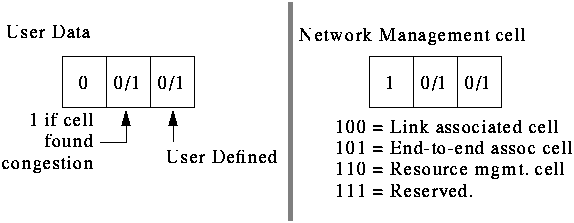
CLP = Cell Loss Priority. 1 - low priority, 0 - high priority (a hint for switches as to which cell to drop)
CRC = Cyclic Redundancy Code -- used for header error detection and correction
Top | Chap 5 | CMPT 365 Home Page | CS